On this page
Key takeaways
- Marketing for a dental practice is mostly three things: be findable, stay in touch with your existing list, and make booking easy.
- Your own patient database is the cheapest channel you have; national survey data shows roughly half of adults see a dental professional in a year, so most of your list is quiet at any time.
- Ahpra rules apply to anything that promotes your practice: no testimonials about clinical care, inducements need terms and conditions, and no urgency pressure.
- Start with one channel done properly for 90 days, then measure enquiries and booked visits, not likes.
Dental marketing in Australia is simpler than the noise suggests. Most practices grow through three moves: be easy to find when someone searches, stay in regular contact with the patients already in your database, and make booking effortless once they decide to come. Everything else — ads, offers, social posts — sits on top of those three. This guide sets out the channels that fit Australian rules, a 90-day plan you can run from the front desk, message templates you can adapt, and the numbers worth measuring.
The national picture supports the focus on your own list. Just over half (53%) of Australians aged 15 and over reported seeing a dental professional in the previous 12 months in the ABS Patient Experiences survey 2023–24, and around 3 in 10 (28%) delayed or avoided dental care when they needed it — with cost named by 18%. In other words, a typical practice database holds many people who simply have not been back this year. Reaching the quiet half of your list usually costs less than finding strangers.
Those numbers also tell you how to speak to patients: people delay for real reasons — cost, fear, time, transport, life events. Marketing that ignores that reads as pressure, and pressure is exactly what Ahpra's advertising rules restrict.
The channels that fit the rules
Practically every dental practice's marketing can be built from five channels. The diagram below shows how they feed one funnel: local search brings people in, your website converts them to enquiries, the front desk books them, and your database keeps them returning.
| Channel | What it does | Best first step |
|---|---|---|
| Your patient database (SMS and email) | Brings quiet patients back for recalls, unscheduled treatment and seasonal campaigns | Audience and consent check, then one monthly message |
| Google Business Profile and reviews | Wins the local map results people check before choosing | Complete the profile, set a review request routine |
| Your website | Turns a search into an enquiry or a booking | Clear services, fees transparency, online booking link |
| Local presence | Schools, sporting clubs, referring specialists | Pick one genuine relationship per quarter |
| Paid ads (optional) | Adds volume on top, not a foundation | Only after the first three channels work |
Ahpra rules in plain English
Ahpra's guidelines for advertising a regulated health service apply to anything that promotes your practice — your website, social media, flyers, even patient recall notices. Section 133 of the National Law says advertising must not: be false or misleading; offer a gift, discount or other inducement unless the terms and conditions are stated; use testimonials about the service; create an unreasonable expectation of beneficial treatment; or encourage the unnecessary use of regulated health services.
Three points matter most for dental marketing. First, testimonials: you cannot use patient comments about clinical aspects of care — symptoms, treatment or outcomes — in your own advertising, and you should remove them from channels you control. Second, reviews on platforms you do not control (like Google) are the patients' own; Ahpra says advertisers are not responsible for removing them there, but a breach can occur if you republish a testimonial on your own site. Third, urgency language like "don't delay" or "act now" tied to health consequences can be unlawful — say what the offer is, plainly, and let patients decide.
Do
- Sell your services on their merits, with honest, verifiable wording
- State the terms and conditions of any offer or discount in the same advertisement
- Ask patients to review you on Google — reviews on the platform are the consumer's own
- Reply to reviews calmly and factually, without quoting them in your own ads
- Keep one clear privacy and consent basis for every campaign
Avoid
- Pasting five-star Google quotes onto your website homepage
- "Don't delay — a small cavity today is a root canal tomorrow" style pressure
- Outcomes or guarantees ("painless", "perfect teeth every time")
- Discount offers with terms that appear only after the click
- Editing reviews, even to remove a clinical mention — Ahpra advises against it
This guide is general information for practice owners. Advertising also touches the Australian Consumer Law, and the TGA regulates advertising of therapeutic goods separately. For anything you plan to spend money on, check Ahpra's current guidelines and get your own advice.
Start with your database, not a stranger's eyeballs
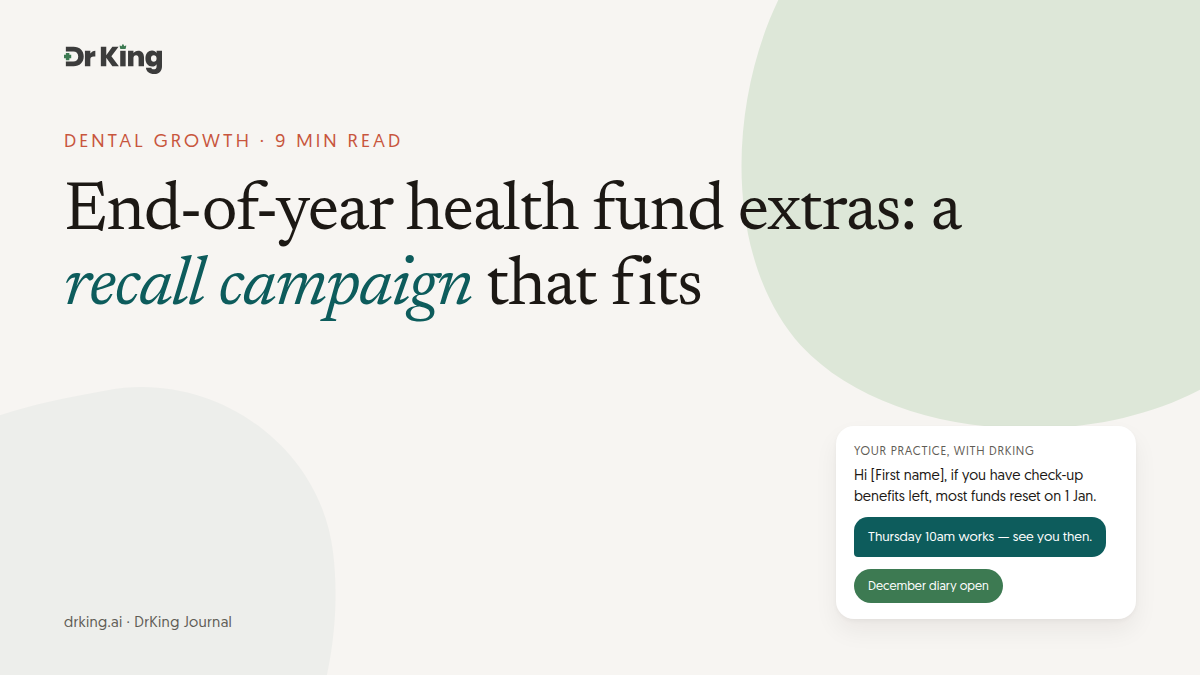
The cheapest campaign you will ever run is a text message to patients who already trust you. The rhythm most practices can sustain: one useful message a month, drawn from a 12-month campaign calendar — recalls, unscheduled treatment follow-up, seasonal check-ins (like end-of-year health fund extras), and reminders. If you have not built a calendar yet, we keep one at patient-reactivation-calendar.
Before the first send, do a consent and hygiene pass. Under the Spam Act 2003, commercial electronic messages need consent, clear sender identification, and a functional unsubscribe — ACMA's guidance sets out all three. Check with your practice software or message provider how opt-outs are handled, and make sure every send offers a way out that actually works.
Example recall text (adapt the wording to your practice)
9:41 AM
9:52 AM
9:53 AM
Three messages, not three weeks of chasing
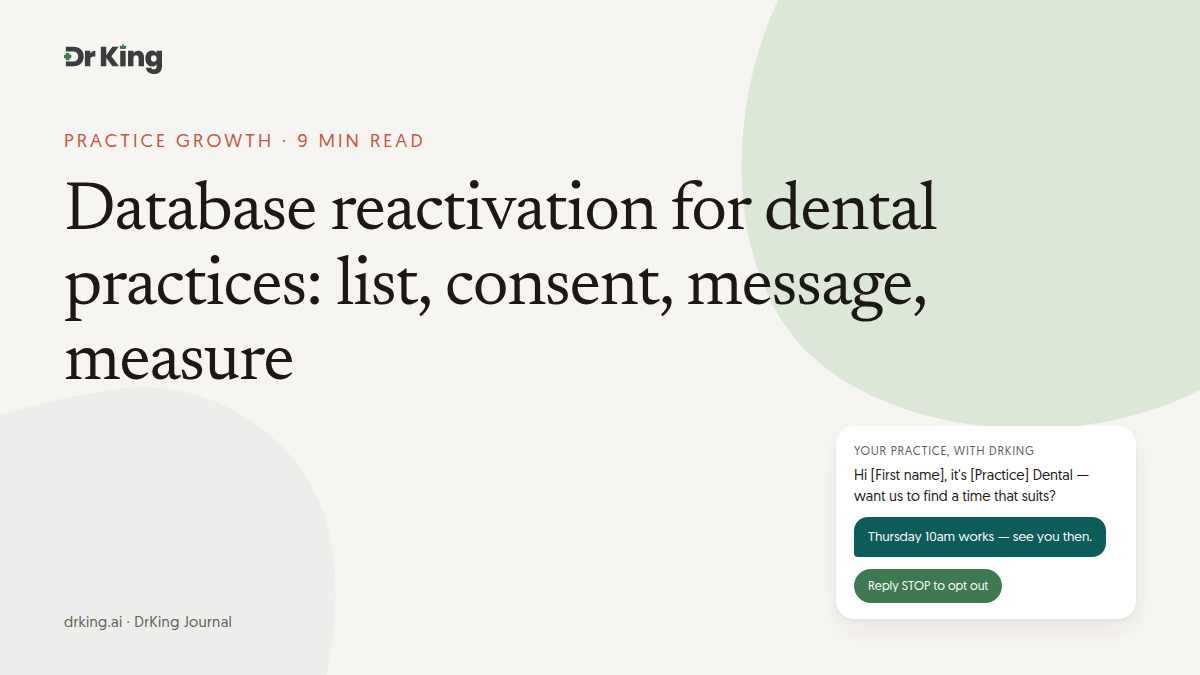
For a reactivation campaign, three touches is a sensible pattern: a friendly opening text, one reminder a few days later, and a final note. The message that usually earns a reply is the one that makes booking effortless — offer two specific times instead of "call us". We cover the full sequence in database-reactivation-for-dental-practices.
Local search and reviews
When someone searches "dentist near me", Google shows a map pack built from your Google Business Profile: hours, services, photos, and reviews. Treat the profile like a second front door. Complete every field, upload real photos of the reception and the street, keep opening hours current, and note accessibility and parking. Then set a review routine: staff mention that reviews help the practice, ideally while the patient is at the desk or in a follow-up message — you can ask, you just cannot write the review for them, incentivise it, or republish a clinical testimonial in your own advertising.
- Claim and completeFill every field of your Google Business Profile; add photos quarterly
- Build the ask into the visitFront desk mentions reviews as patients check out or via a follow-up message
- Reply to everythingThank positives, address complaints factually; never edit or quote reviews in ads
- Watch the map packSearch from your suburb monthly and note where you appear
Reviews interact with Ahpra rules more than most owners expect. The safe pattern is: reviews live on Google; your website describes services in neutral, verifiable language; your social accounts never screenshot a clinical testimonial. We go deeper on the review process in /online-reviews.
Your website and booking path
Your website's job is narrow: answer the three questions a nervous new patient has (what do you do, what will it feel like, how do I book), then convert. That means a booking link that works on a phone, clear information on services and fees, and a page that reflects how the practice actually runs. If your site lists treatments you don't do or hides the booking button three scrolls down, marketing spend on top of that is wasted.
Paid ads come last, not first
Paid search and social can add volume, but they amplify whatever the first three channels already do. If the website confuses people or the front desk doesn't return calls, ads pay to send strangers into a leaky bucket. When the foundation works, start small on one channel, use a landing page with the offer's terms and conditions visible, and check what enquiries actually convert into booked visits — not clicks. Note that paid ads are regulated advertising too: the same Ahpra restrictions on testimonials, inducements and expectations apply, and offers need their terms stated in the ad.
A 90-day plan from the front desk
You do not need a marketing department to do this. Here is a quarterly rhythm a practice manager or reception team can run.
- Weeks 1–2Consent and hygiene pass on the database; complete the Google Business Profile; fix the booking path on your site.
- Weeks 3–6Launch the first monthly campaign (recall or unscheduled treatment follow-up); build the review-asking routine into checkout.
- Weeks 7–10Second campaign (seasonal); reply to every review; check which enquiry sources actually became booked visits.
- Weeks 11–13Review the numbers below; double down on the channel that produced booked visits; set next quarter's calendar.
What to measure (and what to ignore)
Marketing reports usually die in vanity numbers. Track four instead: enquiries by source, booked visits by source, treatment plans presented vs accepted, and patients returning for the recall after their visit. Source tracking matters most for paid spend; without it, you cannot tell a busy phone day from a profitable one. We keep a metrics guide at /analytics.
Where DrKing fits
DrKing gives Australian dental practices one inbox for every lead and patient conversation, with AI two-way messaging across web chat, phone (AI voice receptionist), SMS, email, WhatsApp, Facebook and Instagram. It handles missed-call text-back, online booking, appointment reminders and review requests, plus monthly database reactivation and SMS/email campaigns on a 12-month campaign calendar — including follow-up of patients who accepted a treatment plan but didn't book. Source and conversion tracking shows which channel produced each enquiry. Depending on your practice software setup, it works alongside the tools you already run. If you want to see the flow, book a demo.
Sources
- Guidelines for advertising a regulated health service — Ahpra
- Dental and oral health overview (dental visits data) — Australian Institute of Health and Welfare
- Avoid sending spam (Spam Act 2003 guidance) — ACMA
- What can and cannot be advertised to the general public — Therapeutic Goods Administration